Wednesday, March 17, 2010
Family Tree Blues
One thing led to the next, and I found myself doing a quick google of some of my ancestors. I was a little curious whether they were Acadians, Creoles, or just French Canadians like I've always thought. <- I'm still not sure, especially since they were French Canadians settled in Quebec territory (what is now midwest portions of the US), but then they slowly made their way south to Missouri and Louisiana.
I've always been proud of that portion of the family history - because yay. They were original settlers. <- That ranks just as much bragging points as saying that your ancestors came over on the Mayflower.
OK, it's different, I know.
Doing a google, I discovered that the French settlers in Missouri turf thereof were slave owners. As in, they owned Indian slaves. Or they owned both indian and black slaves, which begot children of mixed marriages who were born into slavery. When the Spanish won the lottery and took over the southern territories, they forced the French to give up their indian slaves, as it was against their laws. The people didn't always give up their 'inheritances' and ugh! When the US purchased the territories, the settlers threw a party because they could keep slaves again.
UGH. UGH. UGH. UGH.
*stabs horrible ancestors*
How can I brag about the ancestors knowing they were slave owners? <- On one hand, I know that several of my ancestors intermarried with Indians through all this and they were a large family. But that doesn't make up for the ones who were gleeful slave owners. Horrible. >.<
Aside from that -
Note to self:
When I get around to cleaning up Swapped Fate, I need to look more closely into the Acadians. <- The novel is a fantasy and takes place in a world far, far away. But I did base it a little bit on the French flight and forced emmigration. I see now where I cut corners and where I can make the novel stronger.
I might even include my HORRIBLE ancestors and their crimes against humanity. It would give me a chance to express my disgusted and disgruntled feelings through one of my characters.
Read more >>
I've always been proud of that portion of the family history - because yay. They were original settlers. <- That ranks just as much bragging points as saying that your ancestors came over on the Mayflower.
OK, it's different, I know.
Doing a google, I discovered that the French settlers in Missouri turf thereof were slave owners. As in, they owned Indian slaves. Or they owned both indian and black slaves, which begot children of mixed marriages who were born into slavery. When the Spanish won the lottery and took over the southern territories, they forced the French to give up their indian slaves, as it was against their laws. The people didn't always give up their 'inheritances' and ugh! When the US purchased the territories, the settlers threw a party because they could keep slaves again.
UGH. UGH. UGH. UGH.
*stabs horrible ancestors*
How can I brag about the ancestors knowing they were slave owners? <- On one hand, I know that several of my ancestors intermarried with Indians through all this and they were a large family. But that doesn't make up for the ones who were gleeful slave owners. Horrible. >.<
Aside from that -
Note to self:
When I get around to cleaning up Swapped Fate, I need to look more closely into the Acadians. <- The novel is a fantasy and takes place in a world far, far away. But I did base it a little bit on the French flight and forced emmigration. I see now where I cut corners and where I can make the novel stronger.
I might even include my HORRIBLE ancestors and their crimes against humanity. It would give me a chance to express my disgusted and disgruntled feelings through one of my characters.

Do you Ring?
I was doing a little research for a friend on wedding rings, symbolism, history - and I came across some FASCINATING information that I'd like to use somewhere in a WIP.
Check this link out for the website + info that inspired me...
It was a while back that I paid a visit to the Henry Ford Museum in Detroit with my family. That museum isn't just about cars. They have a lot of stuff there, sharing the history of peoples who lived in this area. Some of it is history you can touch. Others are enclosed behind glass cases with information posted nearby.
It was here I realized that people did not always exchange actual rings upon getting married. Only the wealthy or upper classes had money to purchase gold rings (or such) for their brides. Some people were more into hair and brooches - something that really grossed me out at the time, actually.
During the recent research too, I discovered -
1. Guys only recently started wearing wedding rings. They did so during WWII, as a reminder of the gals back home while they were fighting. Historically, only women received that particular item as a part of the wedding. Guys DID wear rings for other reasons, just not to show they were taken.
2. The wedding ring used to symbolize ownership - as in, the woman was property of the guy who wed her.
3. The ring's circular shape symbolizes eternity, which is why it came to be used as a particular symbol of marriage. <- This despite the fact that divorces DID happen during ancient times, particularly Rome.
4. The EGYPTIANS were the first to begin wearing wedding rings. I know I shouldn't be surprised, but still, I didn't expect that.
More to the point, the above link had two items which almost caused a FLASH for me -
I was thinking - WOW. Can you imagine receiving a ring that is really a key that opens something special? Yes, I know this has been done before, but I'm still thinking about the possibilities here.
And elsewhere, I came across this:
The above was taken from here.
And also this:
The first is a historical romance writer's DREAM. Heheh. And it could work in fantasy too, especially if you are trying to get away from earthian (and Christian) influences.
The other one -
 <- A Turkish puzzle ring <- Is something I want to use in a Bluebeardesque story. :]
Read more >>
Check this link out for the website + info that inspired me...
It was a while back that I paid a visit to the Henry Ford Museum in Detroit with my family. That museum isn't just about cars. They have a lot of stuff there, sharing the history of peoples who lived in this area. Some of it is history you can touch. Others are enclosed behind glass cases with information posted nearby.
It was here I realized that people did not always exchange actual rings upon getting married. Only the wealthy or upper classes had money to purchase gold rings (or such) for their brides. Some people were more into hair and brooches - something that really grossed me out at the time, actually.
During the recent research too, I discovered -
1. Guys only recently started wearing wedding rings. They did so during WWII, as a reminder of the gals back home while they were fighting. Historically, only women received that particular item as a part of the wedding. Guys DID wear rings for other reasons, just not to show they were taken.
2. The wedding ring used to symbolize ownership - as in, the woman was property of the guy who wed her.
3. The ring's circular shape symbolizes eternity, which is why it came to be used as a particular symbol of marriage. <- This despite the fact that divorces DID happen during ancient times, particularly Rome.
4. The EGYPTIANS were the first to begin wearing wedding rings. I know I shouldn't be surprised, but still, I didn't expect that.
More to the point, the above link had two items which almost caused a FLASH for me -
The Greek and Roman bridegroom often gave a ring to the bride's father-a practice that was probably a survival of primitive bride purchase. In the second century B. C., the Roman bride was presented with a gold ring. But this she wore only in public. Such a ring was much too precious to wear while tending to household duties; and so the groom gave the bride a second ring - for use in the home - which was usually made of iron and had little knobs in the form of a key. Of course, these "key" rings were weak and could open only those locks requiring very little force to turn, but their significance, in that the wearer had the right to seal up the giver's possessions, was strong.
I was thinking - WOW. Can you imagine receiving a ring that is really a key that opens something special? Yes, I know this has been done before, but I'm still thinking about the possibilities here.
And elsewhere, I came across this:
To Obey
Although the Ancient Romans placed a ring on the fourth finger of their wives hands, the practice had little to do with love and devotion. Rather, wives were a possession to the Romans and the ring was a sign of ownership. Ancient Roman women had no voice in this decision; there was no proposal. Once the women were captured and "ringed," they were married.
The above was taken from here.
And also this:
Some 2000 years ago, Asian puzzle rings were commonly used as wedding bands. It is said that sheiks and sultans required each of their wives to wear one as a pledge of fidelity while he was away.
If for some reason, the woman removed her ring, it would fall apart and be very difficult to put back together without knowing the answer to the puzzle.
The first is a historical romance writer's DREAM. Heheh. And it could work in fantasy too, especially if you are trying to get away from earthian (and Christian) influences.
The other one -
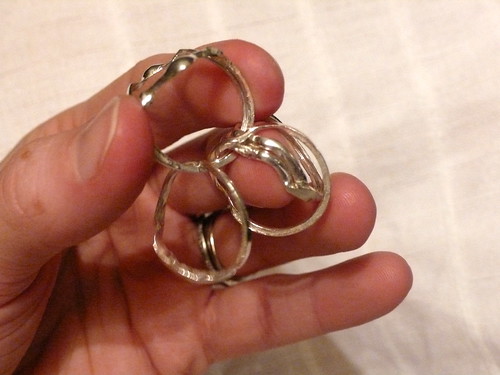 <- A Turkish puzzle ring <- Is something I want to use in a Bluebeardesque story. :]
Tuesday, March 16, 2010
QRY B4 U R DN
*Yes, I suck at txt speak*
I wonder why people do this... querying before they finished writing the novel, even with all of the information and conversation (especially within their critting and writing groups) advising people to keep low until they have a completed and polished novel to hand around.
I know there are people who want to get experience with querying and know they aren't going to have any nibbles on the line. I'm not so much talking about them, because they definitely aren't building their castles before they bought the land.
I'm talking about the other people... like those who have done all the homework and know how the publishing industry works. They seem to have their heads on straight. But then they send a query out for a partially completed novel and start talking about all the money they will make with that novel when it's accepted.
I really sincerely hope that they will prove me wrong and make it... but dude. Where does this come from?
Yeah, it might be three months before you get a response, but what happens if you hit a wall and can't finish and have the novel critiqued in time? Life is unpredictable. You might find yourself in a position where you can't find time to write. So there you might be with an incomplete novel when the nibble happens.
Then there is the miraculous possibility in that an agent or editor might find your sub on their desk within a week and request more. They have made it clear that they do not want incomplete or rough submissions, so what will their reaction be if you have to tell them that you still need to finish the book?
In movies or books, the agent or editor is this frazzled person chasing the author around and begging them to finish the novel so they could PUBLISH it. In real life, they only make that effort for the big names who are guaranteed sales no matter what they write.
I could be overthinking this, especially since the person I'm thinking about did submit to a publisher vs agent. Publishers, especially the bigger ones, are notoriously slow to respond. That will give this person plenty of time to finish her novel. <- That doesn't make me less squeamy about sending too early and suffering the panic attack when the response comes 6 months or even a year early. But then that leads into the other point. Publishers do not rush and publish things so that authors can reap the winnings. And this author is banking on getting paid soon.
Read more >>
I wonder why people do this... querying before they finished writing the novel, even with all of the information and conversation (especially within their critting and writing groups) advising people to keep low until they have a completed and polished novel to hand around.
I know there are people who want to get experience with querying and know they aren't going to have any nibbles on the line. I'm not so much talking about them, because they definitely aren't building their castles before they bought the land.
I'm talking about the other people... like those who have done all the homework and know how the publishing industry works. They seem to have their heads on straight. But then they send a query out for a partially completed novel and start talking about all the money they will make with that novel when it's accepted.
I really sincerely hope that they will prove me wrong and make it... but dude. Where does this come from?
Yeah, it might be three months before you get a response, but what happens if you hit a wall and can't finish and have the novel critiqued in time? Life is unpredictable. You might find yourself in a position where you can't find time to write. So there you might be with an incomplete novel when the nibble happens.
Then there is the miraculous possibility in that an agent or editor might find your sub on their desk within a week and request more. They have made it clear that they do not want incomplete or rough submissions, so what will their reaction be if you have to tell them that you still need to finish the book?
In movies or books, the agent or editor is this frazzled person chasing the author around and begging them to finish the novel so they could PUBLISH it. In real life, they only make that effort for the big names who are guaranteed sales no matter what they write.
I could be overthinking this, especially since the person I'm thinking about did submit to a publisher vs agent. Publishers, especially the bigger ones, are notoriously slow to respond. That will give this person plenty of time to finish her novel. <- That doesn't make me less squeamy about sending too early and suffering the panic attack when the response comes 6 months or even a year early. But then that leads into the other point. Publishers do not rush and publish things so that authors can reap the winnings. And this author is banking on getting paid soon.
Morning Update
I'm still alive (hurray!).
Don't you just hate it when a blog you are following suddenly starts randomly posting brief updates which all say the same thing?
As in, "We is writing. We is happy. Novel is growing like weed. That is bad thing, because is already too long, but we is going to deal with that later."
'Is' is a much better word than 'Was'.
In all seriousness - the novel I've been working on has morphed into something I did not anticipate - but it feels real. Real, as in I might have something publishable if I finish the novel. (._.)
Chapter 1 thru 3 are cleaned up and fully edited. They contain the character intro, plotting hints, and hook.
Chapter 4 thru 6 (what I'm finishing up right now) are semi-clean drafts. I've been writing a chapter at a time and editing it before writing the next one. <- I've been doing this to keep the transitions and pacing smooth. When you keep writing new chapters every night without checking the previous chapters, there is a chance that some choppiness will develop and characters will morph several times (depending on your mood) before you finish the book. By reading over and editing the previous chapter before writing the next, I'm getting a feel for the characters and mood, so I can keep it consistent when I actually start the new writing.
Oh, Chapter 4 thru 6 contain the side character development and plotting development. I'm starting to show all my cards.
My plan for Chapter 7 thru 10 is reaching the climax or farthest point and beginning to resolve the plot and tie loose ends.
Chapter 11 thru 15 will be the completion of the novel. \(^.^)/
Yes - that sounds VERY SHORT for a YA Urb-Fant, but remember that those are very long chapters. I have five completed chapters and the novel is already 26,000 words. <- And yes, I know that is VERY, VERY bad. But that is what final edits are for. Weeding.
The novel is character driven (like everything I write), but there is a strong(ish) plot unveiling itself too - something that really makes me happy. It keeps me interested in writing the novel, and I think that will show in the finished product.
More posts to come later this week. <- And not all of them ENTHUSING about my own writing.
12:30 PM Update
Summons inner Urkel...
"Did I do thaaaat?"
During lunch, I sat in my car to enjoy the fresh early afternoon sunshine and practically balmy (when you have been through a frigid winter, 50 degrees feels like global warming, but in a good way). I had my mini laptop with me and pulled it out to do a little work or light reading.
Rather than look at an outdated version of the current WIP, I opened Gladiitor and I read through the first eight chapters. There are 40 (I think?) chapters in the novel (short ones, so don't freak out).
I did notice my weak spots, or areas where I could have tightened up the text or fixed things, but uh...
It is a GOOD thing when you open an old WIP and realize that there is something good about it, right? I was actually thinking that even though Gladiitor is a sequel, it stands the chance of going out on it's own without the support of the first book.
The first novel is essentially first love angst and figure skating in space. *puts on geek hat* The book ended with the protagonist giving the guy up in favor of pursuing her dream to be a Warrior.
Gladiitor was the dream cracked... um, the Warrior's League falls to shambles and the Warriors are all disbanded. The guy comes back with a renewed offer of partnership on the ice, though he's no longer interested in a real life partnership. He is engaged to somebody else who is wildly planning the marriage while the universe goes nuts around them. Oh and there was a love triangle in Gladiitor.
Heh. It was kind of a soap opera <- Which means it was fun to write and even more fun to read two years later. I forgot a lot of stuff and almost was my own beta reader. (._.)
On that note -
I was doing a little spring cleaning in my closet over the weekend. I'm old-fashioned (or just old) enough to have a huge stack of cd's in my closet. Cleaning means going through and switching cds over to their proper jewel cases.
Mixed in with all my cds was a floppy disk over which I wrote in a thick black sharpie marker - "Russian Skating 2".
I have no idea what that novel is... and I no longer have a computer that reads floppy disks. And even if I did, it is a sure bet that the floppy has demagnetized over the years. Ugh. So, unless I get up the courage to take the disk over to a computer place that specializes in demagnetizing floppy disks or whatever, I'll never know. "Russian Skating 2" will be one of those fragments from my teen years, a novel never completed.
Read more >>
Don't you just hate it when a blog you are following suddenly starts randomly posting brief updates which all say the same thing?
As in, "We is writing. We is happy. Novel is growing like weed. That is bad thing, because is already too long, but we is going to deal with that later."
'Is' is a much better word than 'Was'.
In all seriousness - the novel I've been working on has morphed into something I did not anticipate - but it feels real. Real, as in I might have something publishable if I finish the novel. (._.)
Chapter 1 thru 3 are cleaned up and fully edited. They contain the character intro, plotting hints, and hook.
Chapter 4 thru 6 (what I'm finishing up right now) are semi-clean drafts. I've been writing a chapter at a time and editing it before writing the next one. <- I've been doing this to keep the transitions and pacing smooth. When you keep writing new chapters every night without checking the previous chapters, there is a chance that some choppiness will develop and characters will morph several times (depending on your mood) before you finish the book. By reading over and editing the previous chapter before writing the next, I'm getting a feel for the characters and mood, so I can keep it consistent when I actually start the new writing.
Oh, Chapter 4 thru 6 contain the side character development and plotting development. I'm starting to show all my cards.
My plan for Chapter 7 thru 10 is reaching the climax or farthest point and beginning to resolve the plot and tie loose ends.
Chapter 11 thru 15 will be the completion of the novel. \(^.^)/
Yes - that sounds VERY SHORT for a YA Urb-Fant, but remember that those are very long chapters. I have five completed chapters and the novel is already 26,000 words. <- And yes, I know that is VERY, VERY bad. But that is what final edits are for. Weeding.
The novel is character driven (like everything I write), but there is a strong(ish) plot unveiling itself too - something that really makes me happy. It keeps me interested in writing the novel, and I think that will show in the finished product.
More posts to come later this week. <- And not all of them ENTHUSING about my own writing.
12:30 PM Update
Summons inner Urkel...
"Did I do thaaaat?"
During lunch, I sat in my car to enjoy the fresh early afternoon sunshine and practically balmy (when you have been through a frigid winter, 50 degrees feels like global warming, but in a good way). I had my mini laptop with me and pulled it out to do a little work or light reading.
Rather than look at an outdated version of the current WIP, I opened Gladiitor and I read through the first eight chapters. There are 40 (I think?) chapters in the novel (short ones, so don't freak out).
I did notice my weak spots, or areas where I could have tightened up the text or fixed things, but uh...
It is a GOOD thing when you open an old WIP and realize that there is something good about it, right? I was actually thinking that even though Gladiitor is a sequel, it stands the chance of going out on it's own without the support of the first book.
The first novel is essentially first love angst and figure skating in space. *puts on geek hat* The book ended with the protagonist giving the guy up in favor of pursuing her dream to be a Warrior.
Gladiitor was the dream cracked... um, the Warrior's League falls to shambles and the Warriors are all disbanded. The guy comes back with a renewed offer of partnership on the ice, though he's no longer interested in a real life partnership. He is engaged to somebody else who is wildly planning the marriage while the universe goes nuts around them. Oh and there was a love triangle in Gladiitor.
Heh. It was kind of a soap opera <- Which means it was fun to write and even more fun to read two years later. I forgot a lot of stuff and almost was my own beta reader. (._.)
On that note -
I was doing a little spring cleaning in my closet over the weekend. I'm old-fashioned (or just old) enough to have a huge stack of cd's in my closet. Cleaning means going through and switching cds over to their proper jewel cases.
Mixed in with all my cds was a floppy disk over which I wrote in a thick black sharpie marker - "Russian Skating 2".
I have no idea what that novel is... and I no longer have a computer that reads floppy disks. And even if I did, it is a sure bet that the floppy has demagnetized over the years. Ugh. So, unless I get up the courage to take the disk over to a computer place that specializes in demagnetizing floppy disks or whatever, I'll never know. "Russian Skating 2" will be one of those fragments from my teen years, a novel never completed.
Friday, March 12, 2010
Info Snag: Ranks of Nobility
I figured this would come in handy at some point...
I'm at work right now, but am planning to look up and type in the definitions of some of these. Like, Erfridder looked like Elfrider to me. And what's with the knights?! :)
I'm probably not going to be writing the type of novel that calls for titles like these (I'm allergic to using Europe as a setting, only because everyone else does). But at some point when I pick up one of my fantasy type novels (NSAM), I could use these as a guide when I'm setting up a system.
Ranks of Nobility
*Emperor & Empress
*King & Queen
*Archduke & Archduchess
*Grand Duke & Grand Duchess
*Duke & Duchess
Prince & Princess
Infante & Infanta
*Marquess & Marchioness
Marquis & Marquise
Margrave & Margravine
*Count & Countess
Earl & Countess
*Viscount & Viscountess
*Baron & Baroness
*Baronet & Baronetess
Nobile, Edler von, panek
Ritter, Erfridder
*Hereditary Knight
Black Knight, White Knight, Green Knight
*Knight & Dame
- snipped from Wiki
Random Suggestion:
Let's say you are one of those people who is writing a book (historical, fantasy, romance) based in Europe. Please pay attention to details - especially those that can annoy or distract a reader.
I recently came across a fascinating synopsis by a fellow writer. This person clearly had skillz and knew the genre, and I was really hooked by the idea and hoped to get a chance to read the book.
There was one blemish that this book had, and I was wondering if the author was having a hard time placing the book because of this blemish... this would be the names which the author chose for the main characters.
I'm not going to give them here, because it might identify the author, but it really isn't a good idea to use names of major figures in history. And I mean names that would be immediately recognizable to anyone who likes history (like moi).
If your character is fictional, try to give them fictional names.
A good example would be writing a American Revolution era historical novel, and giving the main character a name like Georgiana Washington. :O
Read more >>
I'm at work right now, but am planning to look up and type in the definitions of some of these. Like, Erfridder looked like Elfrider to me. And what's with the knights?! :)
I'm probably not going to be writing the type of novel that calls for titles like these (I'm allergic to using Europe as a setting, only because everyone else does). But at some point when I pick up one of my fantasy type novels (NSAM), I could use these as a guide when I'm setting up a system.
Ranks of Nobility
*Emperor & Empress
*King & Queen
*Archduke & Archduchess
*Grand Duke & Grand Duchess
*Duke & Duchess
Prince & Princess
Infante & Infanta
*Marquess & Marchioness
Marquis & Marquise
Margrave & Margravine
*Count & Countess
Earl & Countess
*Viscount & Viscountess
*Baron & Baroness
*Baronet & Baronetess
Nobile, Edler von, panek
Ritter, Erfridder
*Hereditary Knight
Black Knight, White Knight, Green Knight
*Knight & Dame
- snipped from Wiki
Random Suggestion:
Let's say you are one of those people who is writing a book (historical, fantasy, romance) based in Europe. Please pay attention to details - especially those that can annoy or distract a reader.
I recently came across a fascinating synopsis by a fellow writer. This person clearly had skillz and knew the genre, and I was really hooked by the idea and hoped to get a chance to read the book.
There was one blemish that this book had, and I was wondering if the author was having a hard time placing the book because of this blemish... this would be the names which the author chose for the main characters.
I'm not going to give them here, because it might identify the author, but it really isn't a good idea to use names of major figures in history. And I mean names that would be immediately recognizable to anyone who likes history (like moi).
If your character is fictional, try to give them fictional names.
A good example would be writing a American Revolution era historical novel, and giving the main character a name like Georgiana Washington. :O
Wednesday, March 3, 2010
BOOKMARK: FIRST PAGES
Muy Importante!
If you are in the revision stage and trying to get your novel ready for 'ither eyes', you need to take a look at the fabulous list of elements to avoid in your first 50 pages which blogger Lindsey Edwards of The Write Words has compiled. Go directly to her blog. *looks bossy* Remember, revising isn't just about running find/replace searches for adverbs and words from the naughty list (was, been, felt, almost, very, practically, almost, etc).
Personally speaking, these following are things I'm spotting in my own writing (currently BSW) as I revise and rewrite:
Every paragraph seems to start with the same word.
Oh. My. Goodness.
I wrote a 4000 word chapter yesterday and felt quite smug about it... until I glanced over the chapter as a whole and noticed all of the paragraphs which started with the progagonist's name, or "she". Ghastly! <- Guess what I'll be editing later today. Blegh. T_T
Unnecessary sentences.
This is something I'm paying attention to both while I'm writing and also when I'm editing. Because I'm writing a YA book, I know I need to keep the writing tight and the pace fast. You don't want to keep saying the same thing over and over again, or tell the reader something that you already made clear by the situation or the characters' actions.
Too much emphasis on the mundane.
This is the reason why I cut an entire chapter a couple days ago (this is the chapter I wrote fresh yesterday). Every scene should be crafted with the objective of furthering the plot. I told myself that I didn't need to take the reader through a full school day with the protagonist, because most people already know full well what school is like. Cut the scene focuses down to those where SOMETHING HAPPENS. Even when you are providing a setting and trying to put a reader there in the classroom with your character. You shouldn't have scenes where nothing happens except for the character describing the four walls of the classroom, the smell of lysol and erasers, tables and chairs, sounds of students shuffling about and breathing. Even if you provide details like that in a scene, there needs to be a bigger plot FOCUS. Something that happens outside the norm.
Too much back story.
Yep. This is something I'll be doing in the next revision round, though I did make a lot of progress this time around. Initially, I dedicated half the first chapter to explaining why the characters were in boarding school and what life was like there in BS and other background stuff like that before I moved on with the story.
Back story is important, but you need to keep it tight and you want to provide it in pieces instead of all at once.
Stiff conversation between characters.
*NODS GUILTILY* I had that problem with the protagonist and some of the other characters. It reminded me of playing dolls with my niece when she was small and shy about getting into total doll-playing mode.
It was a lot of:
"Hi, how are you?"
"I'm fine. Nice weather we have outside, huh?"
"Yes. I like your dress."
"Why thank you. I like your dress too."
[awkward silence while dolls are moved around to different standing positions]
"Well, I have to go now. Bye."
"OK. Bye."
[end of scene]
[[[Giggles]]]
The worst is dialogue like this gets filed under mundane and unnecessary sentences, as mentioned above. Like everything else, dialogue needs to serve a purpose.
The way to fix this... I saw somewhere around the web somebody said to write the dialogue first and not worry about it. As you revise, you can add the dialogue beats or actions. And you can touch up on the dialogue itself, making it less robotic.
Just food for thought and kudos to Lindsey for posting that list. It does help - especially if you are new at this and don't know where to begin.
Read more >>
If you are in the revision stage and trying to get your novel ready for 'ither eyes', you need to take a look at the fabulous list of elements to avoid in your first 50 pages which blogger Lindsey Edwards of The Write Words has compiled. Go directly to her blog. *looks bossy* Remember, revising isn't just about running find/replace searches for adverbs and words from the naughty list (was, been, felt, almost, very, practically, almost, etc).
Personally speaking, these following are things I'm spotting in my own writing (currently BSW) as I revise and rewrite:
Every paragraph seems to start with the same word.
Oh. My. Goodness.
I wrote a 4000 word chapter yesterday and felt quite smug about it... until I glanced over the chapter as a whole and noticed all of the paragraphs which started with the progagonist's name, or "she". Ghastly! <- Guess what I'll be editing later today. Blegh. T_T
Unnecessary sentences.
This is something I'm paying attention to both while I'm writing and also when I'm editing. Because I'm writing a YA book, I know I need to keep the writing tight and the pace fast. You don't want to keep saying the same thing over and over again, or tell the reader something that you already made clear by the situation or the characters' actions.
Too much emphasis on the mundane.
This is the reason why I cut an entire chapter a couple days ago (this is the chapter I wrote fresh yesterday). Every scene should be crafted with the objective of furthering the plot. I told myself that I didn't need to take the reader through a full school day with the protagonist, because most people already know full well what school is like. Cut the scene focuses down to those where SOMETHING HAPPENS. Even when you are providing a setting and trying to put a reader there in the classroom with your character. You shouldn't have scenes where nothing happens except for the character describing the four walls of the classroom, the smell of lysol and erasers, tables and chairs, sounds of students shuffling about and breathing. Even if you provide details like that in a scene, there needs to be a bigger plot FOCUS. Something that happens outside the norm.
Too much back story.
Yep. This is something I'll be doing in the next revision round, though I did make a lot of progress this time around. Initially, I dedicated half the first chapter to explaining why the characters were in boarding school and what life was like there in BS and other background stuff like that before I moved on with the story.
Back story is important, but you need to keep it tight and you want to provide it in pieces instead of all at once.
Stiff conversation between characters.
*NODS GUILTILY* I had that problem with the protagonist and some of the other characters. It reminded me of playing dolls with my niece when she was small and shy about getting into total doll-playing mode.
It was a lot of:
"Hi, how are you?"
"I'm fine. Nice weather we have outside, huh?"
"Yes. I like your dress."
"Why thank you. I like your dress too."
[awkward silence while dolls are moved around to different standing positions]
"Well, I have to go now. Bye."
"OK. Bye."
[end of scene]
[[[Giggles]]]
The worst is dialogue like this gets filed under mundane and unnecessary sentences, as mentioned above. Like everything else, dialogue needs to serve a purpose.
The way to fix this... I saw somewhere around the web somebody said to write the dialogue first and not worry about it. As you revise, you can add the dialogue beats or actions. And you can touch up on the dialogue itself, making it less robotic.
Just food for thought and kudos to Lindsey for posting that list. It does help - especially if you are new at this and don't know where to begin.
Monday, March 1, 2010
Skull Bumps
This topic came up while I sat debating whether I should call the doctor about a bump on my head. It feels like bone - like my skull is just shaped wrong in the one spot.
Like any other hypo, I went online to figure out what the bony bump could be.
The info is taken from a website, see link below:
It sounds like my golden retriever's occiput. :)
The bump I have is not quite in line with my neck/spine. It's more to the left. I do not know if that still counts as a Anatolian bump (not impossible, as some of my ancestors were from what is now modern day Turkey). <- Hence I will check with my doctor, just to be safe.
Still!
I decided to stash the skull information away where I can find it later. There is a book I'm working on where I have members of a certain race sneaking around on a planet of another race. <- I was just getting tired of having the racial differences being based on skin and hair color. I like the idea of having the races divided based on something different - like the shape of their skulls. Easier to disguise, as long there aren't scalp checks. A golf sized bump on the back of everyone's skull seems to be one of those more likely genes that could get passed around through a planetary system. More likely than having everyone in X planetary system be blond. :L
The other option is the length of their toes. <- Anything foot related grosses me out, so I'm not overeager to go this route. -> But I did read one of those random old wives tales type things where the descendants of royalty can be identified by their feet. Apparently, their second toe is always longer than the rest of the toes.
With the bump - that is something that could be exagerated or artificially created. I'm sure I wasn't the only one fascinated in history class when I read about the Mayans who had the same head binding practices as the Egyptians.

Fascinating details, eh? And it gets better - according to Wiki, Australian aborigines and then Native Americans were also known to practice the same cradling methods. Also the Huns.
Random add here - Eric van Daniken observed these similarities in ancient peoples, and took it to mean they were all binding their heads to imitate the alien god who visited them and taught them industrial and mechanical mysteries.
Stargate SG1 creators read Eric van Daniken's book. I'm convinced. :]
ETA - Do check this link out for a fascinating detail on the Melungeons. I've never heard of these people until today when I was looking up the Anatolian bump/ridge. Apparently these are a strange group of people who lived in the Tennessee/Virginia/Kentucky mountain areas. There is a mystery as to where these people came from, especially since they spoke an odd language and had a jumbled mixture of physical traits.
They were also known to have a lot of six fingered people among their group, or it was highly hereditary.
Fascinating stuff.
Read more >>
Like any other hypo, I went online to figure out what the bony bump could be.
The info is taken from a website, see link below:
There are some physiological characteristics which are called ethnic markers, that seem to be passed on through the lines of some Melungeon descendants. There is a bump on the back of the HEAD of SOME descendants, that is located at mid-line, just ABOVE the juncture with the neck. It is about the size and shape of half a golf ball or smaller. This is called an ANATOLIAN BUMP, and indicates ancestry from the Anatolian region of Turkey. If you cannot find the bump, check to see if you, like some descendants, including myself, have a ridge, located at the base of the head where it joins the neck, rather than the Anatolian bump.
This ridge is an enlargement of the base of the skull, which is called a Central Asian Cranial Ridge. My ridge is quite noticeable. It is larger than anyone else's that I have felt, except my father's. I can lay one finger under it and the ridge is as deep as my finger is thick. Other ridges are smaller. To find a ridge, place your hand at the base of your neck where it joins your shoulders, and on the center line of your spine. Run your fingers straight up your neck toward your head. If you have a ridge, it will stop your fingers from going on up and across your head.
http://www.melungeonhealth.org/info.html
It sounds like my golden retriever's occiput. :)
The bump I have is not quite in line with my neck/spine. It's more to the left. I do not know if that still counts as a Anatolian bump (not impossible, as some of my ancestors were from what is now modern day Turkey). <- Hence I will check with my doctor, just to be safe.
Still!
I decided to stash the skull information away where I can find it later. There is a book I'm working on where I have members of a certain race sneaking around on a planet of another race. <- I was just getting tired of having the racial differences being based on skin and hair color. I like the idea of having the races divided based on something different - like the shape of their skulls. Easier to disguise, as long there aren't scalp checks. A golf sized bump on the back of everyone's skull seems to be one of those more likely genes that could get passed around through a planetary system. More likely than having everyone in X planetary system be blond. :L
The other option is the length of their toes. <- Anything foot related grosses me out, so I'm not overeager to go this route. -> But I did read one of those random old wives tales type things where the descendants of royalty can be identified by their feet. Apparently, their second toe is always longer than the rest of the toes.
With the bump - that is something that could be exagerated or artificially created. I'm sure I wasn't the only one fascinated in history class when I read about the Mayans who had the same head binding practices as the Egyptians.

Head flattening, also called head binding, head shaping or head moulding, is the application of pressure or bindings to cranial bones (the human skull) to alter their shapes. Flat shapes, elongated ones (produced by binding between two pieces of wood), rounded ones (binding in cloth) and conical ones are among those chosen. It is typically carried out on an infant, as the skull is most pliable at this time. In a typical case, headbinding begins approximately a month after birth and continues for about six months.
Usually it is a part of a cultural ritual, aimed at creating a skull shape which is aesthetically more pleasing or associated with desirable attributes such as intelligence. For example, in the Nahai-speaking area of Tomman Island and the south south-western Malalukan, a person with a finely elongated head is thought to be more intelligent, of higher status, and closer to the world of the spirits.
http://en.wikipedia.org/wiki/Head_flattening
Fascinating details, eh? And it gets better - according to Wiki, Australian aborigines and then Native Americans were also known to practice the same cradling methods. Also the Huns.
Random add here - Eric van Daniken observed these similarities in ancient peoples, and took it to mean they were all binding their heads to imitate the alien god who visited them and taught them industrial and mechanical mysteries.
Stargate SG1 creators read Eric van Daniken's book. I'm convinced. :]
ETA - Do check this link out for a fascinating detail on the Melungeons. I've never heard of these people until today when I was looking up the Anatolian bump/ridge. Apparently these are a strange group of people who lived in the Tennessee/Virginia/Kentucky mountain areas. There is a mystery as to where these people came from, especially since they spoke an odd language and had a jumbled mixture of physical traits.
They are tall, straight, well- formed people, of a dark copper color ... but wooly heads and other similar appendages of our negro.7
They are of swarthy complexion, with prominent cheek bones, jet black hair, generally straight but at times having a slight tendency to curl, and the men have heavy black beards...Their frames are well built and some of the men are fine specimens of physical manhood. They are seldom fat.8
While some of them are swarthy and have high Indian cheekbones, the mountain whites, too, often display these same characteristics. Also, many of the Melungeons have light hair, blue eyes, and fair skin.9
The color of the skin of a full-blooded, pure Melungeon is a much richer brown than an Indian’s skin. It is not the color of a part Indian and part white, for their skin is lighter. The full-blooded, pure Melungeon had more the color of skin of a person from India and Egypt.10 - Taken from Wiki
They were also known to have a lot of six fingered people among their group, or it was highly hereditary.
Gathered under a tent at a public park, about 150 Melungeons had come from around the country (a show of hands indicated that about 70 percent came from states other than Tennessee) to hear results they hoped would tell them something about their heritage.taken from wired.com
Those who were looking for black-and-white answers didn't get them. Jones' rather vague results showed that about 5 percent of the DNA indicated African descent, 5 percent was Native American, and the rest was "Euroasian," a group defined by clumping together Europe, the Middle East and India.
The most surprising finding was evidence of a rare DNA sequence common to a Northern Indian tribe called the Siddis.
The Siddis are descendants of African slaves, sailors and merchants who ended up in India as a result of trade with East Africa, starting in the 12th century and lasting into the 19th. Some of the people were stolen from their homelands and taken as slaves.
They became part of the Indian population known as the "untouchables," and are still marginalized in northwest India.
Fascinating stuff.
Subscribe to:
Posts (Atom)